
Clackamas VINELink Release Check
Oregon replaced the legacy APPRISS VINE interface with VISOR, the Victim Information System in Oregon. Searches for “VINELink Clackamas County” should therefore lead to the Oregon service, not a generic national VINE search. Existing legacy VINE registrations were migrated, so Oregon says prior registrants did not need to start again. VISOR is free, available continuously, and confidential. The person named in the record is not told who registered for an alert.
County and state facilities feed custody events into VISOR. The Clackamas County District Attorney's VISOR guide says users may check whether someone is in a county or state facility or on probation or parole. It also lists phone, text, email, and TTY notification channels. The current Clackamas Sheriff's “Adults in Custody” feature routes to VISOR, making the statewide system the county's live search handoff.
The handoff does not turn VISOR into a historical Clackamas release archive. Its public search statement covers people currently in custody or under supervision. A fully discharged person may not be returned. If the person is gone from the active result set, the former custodian's release record and the court case become the better sources.
Note: “VINELink” describes the familiar search intent, while VISOR is the current official Oregon service and working destination.
Search One Clackamas County Inmate
A reliable check begins with one known person, not a broad browse. VISOR accepts a full name, partial name, Oregon SID, or county ID. An SID is the state's identifying number for a corrections record. It is more precise than a name because different people can share names. When spelling is uncertain, the portal suggests entering the first three letters of the first name, a space, and the first three letters of the last name.
- Open Oregon VISOR and enter a full or partial name, SID, or county ID for the specific person.
- Complete the CAPTCHA. Review all returned matches and use public identifying details to avoid choosing a namesake.
- Open the correct record. Read the exact status, agency, facility, or supervising entity rather than guessing from where the name appears.
- Note whether the result says custody, supervision, release, or transfer. Each label describes a different event or legal state.
- If no match appears, check the former custodian's record and court case. Do not treat an empty result as a release certificate.
For a person booked only at Clackamas County Jail, the sheriff's release transaction remains the formal local source. For a person committed to Oregon DOC, use Oregon Offender Search and DOC records as well. The Clackamas County released inmate search explains how to reconcile those paths when the last custodian is uncertain.
Clackamas VISOR Release Fields
Read the labels as the source presents them. “In custody” and a named facility describe confinement. “Under supervision” generally means physical confinement has ended while probation, parole, or post-prison supervision continues. A projected release date belongs to a current sentence and is not an actual release. A release event says the system received and reported a custody change, but formal proof still comes from the responsible agency.
| VISOR item | What it can show | Key limit |
|---|---|---|
| Person match | A result tied to a name, SID, or county ID | Namesakes require careful selection |
| Custody status | Whether the system reports current custody | Periodic updates may lag the real event |
| Facility or agency | The supplying custodian or supervising body | A transfer is not community release |
| Supervision status | Probation, parole, or another community phase when supplied | It does not mean current incarceration |
| Projected date | A forecast for a current Oregon DOC sentence | It can change and does not prove release occurred |
| Notification option | Available channels for selected custody events | An alert is not a certified record |
The official VISOR landing screen displays the Oregon name and ID search:
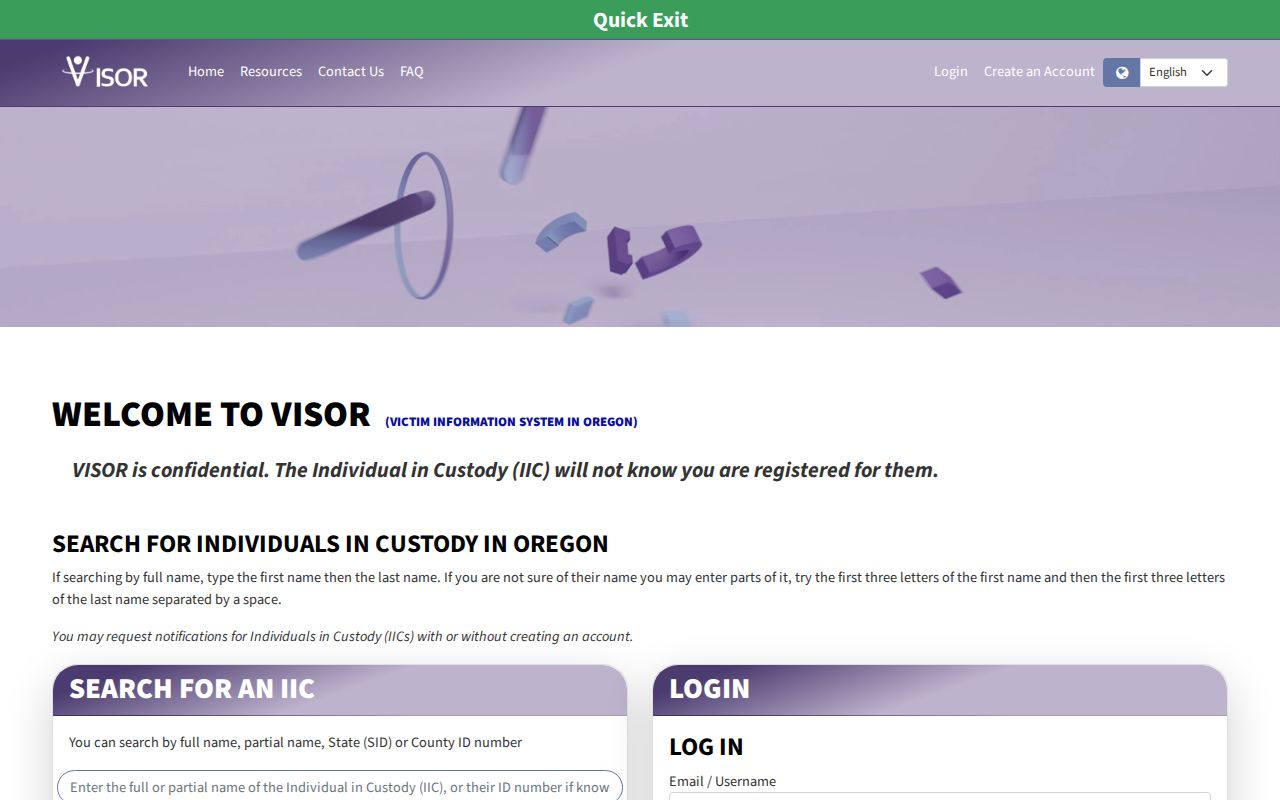
The image shows the correct starting point for one-person custody or supervision lookup, not a list of recently released people.
Register Clackamas Release Alerts
Registration begins only after the correct person has been selected. VISOR supports phone, text, email, or TTY channels. More than one phone number or email address may be supplied. An online account is optional. Creating one lets a registrant review recent notices, change contact methods, and unregister. Without an account, follow the portal's current prompts and confirm the chosen channel.
- Open the correct individual result and choose the registration or notification option.
- Select one or more available phone, text, email, or TTY channels.
- Enter accurate contact details. Add another channel when a backup method would help.
- Follow the live confirmation prompts for each selected method and retain the registration confirmation.
- Update or cancel the registration through the account tools, or use VISOR support when assistance is needed.
Current official Oregon VISOR instructions do not document a PIN requirement. Do not copy an old four-digit PIN workflow from another state or an earlier platform. Registration should follow the confirmation process shown by the live Oregon portal. Staff assistance is available at visor@doc.oregon.gov or 888-749-8080, where the state asks callers to leave a voicemail. The portal lists 855-691-6246 for notification, website, and registration help around the clock.
Note: Alerts work best when registered before the custody change because they do not create a past release document after the fact.
Clackamas Custody Change Notices
The Clackamas DA guide lists advance release, release, transfer, death, legal-name change, escape, recapture, and return to custody among VISOR events. Oregon DOC also describes advance notice that can include a 30-day release notice. The state's sentence-recalculation material says qualifying projected-date changes, moves, and releases can generate notifications every two hours. That is a notification cadence for specific state events, not a promise that every county data source refreshes on the same schedule.
Each notice should be read narrowly. A “released” alert reports what VISOR received from the contributing system. A “transfer” alert means a move between custodians or sites. “Return to custody” can follow a supervision matter and does not itself state whether a new case exists. Save the alert and its time if it helps trace the event, then seek the originating agency's record for exact date, time, disposition, and legal authority.
Advance notice and final release notice also serve different needs. An advance notice is based on a date that may still change through credit review, a court amendment, or a hold. The later event alert reports a change supplied to VISOR. Neither one reveals every step in the release plan. For an Oregon prison case, DOC may send the person to Clackamas community corrections, short-term transitional leave, or another authority on a detainer. For a county case, CCSO may record security release, recognizance, time served, a court order, or transfer. The notice should therefore prompt a source check, not a broader claim about the person's legal status.
- Release alert
- A system report that custody ended at the contributing agency.
- Transfer alert
- A notice that custody moved rather than necessarily ended.
- Advance notice
- A prospective notice based on a date that may still change.
- Return to custody
- A reported new custody event, which requires an agency record to explain its basis.
Clackamas Jail and DOC Records
VISOR bridges county and state information, but the underlying records remain separate. A person released from Clackamas County Jail after security, recognizance, time served, or a court order may never enter Oregon DOC. Ask CCSO for the booking sheet and custody or release transaction, including physical release date, release type, releasing authority, and transfer destination if public. Jail information is available at 503-722-6777, while the CCSO Records Unit is reached at 503-785-5200.
An Oregon state prisoner belongs in the legacy Oregon Offender Search and DOC records system. A different listed prison is usually a transfer. A supervision result indicates that physical prison confinement ended but legal supervision continues. A fully discharged person can fall outside VISOR's stated search population, so a DOC Pen Pack, Board order, or court judgment may be needed for historical proof.
The Clackamas Circuit Court case explains the legal basis for a release order, sentence, or probation term. It may not record the exact moment someone walked out of the jail. The custodial record answers when physical custody changed, while the court record answers why.
Note: Keep county-jail release, state-prison release, supervision, and final discharge as four distinct facts whenever the records support them.
Clackamas VISOR Release Limits
VISOR does not replace federal or immigration custody searches. Use the Bureau of Prisons Inmate Locator for a federal prison term. A result marked “Released” with a past date ends BOP custody, though it does not rule out federal supervision or another agency's custody. Federal pretrial and transport cases handled by the U.S. Marshals Service may not appear as BOP prison records.
Use the ICE Online Detainee Locator System for current immigration detention. An empty result may reflect transfer, release, removal, data limits, or incorrect inputs. If a Clackamas release transaction says the person was released to ICE or the U.S. Marshals Service, that is continued custody under another authority, not proof of community release.
VISOR itself warns that data is updated periodically, may change, and is not an official law-enforcement record. Confirm a county event through CCSO, a prison event through Oregon DOC, a Board-governed event through a written Board Action, and the legal basis through the court. That fallback chain protects against data lag, namesake errors, and the loss of a result after full discharge.