
No Clackamas 72-Hour Release Feed
The mandatory official-channel review found no CCSO page that functions as a rolling list of people released during the last three days. The sheriff labels its tool Adults in Custody, and the current application routes that feature to Oregon VISOR. VISOR searches current custody and supervision. It does not expose a Clackamas County 72-hour archive.
The term “72 hour release list” is therefore a search intent, not the name of a county product. For a weekend or three-day period, request a jail release log bounded by precise dates and times. Ask for nonexempt fields to be provided after exempt details are redacted. A current-search result and the court case can help reconcile what happened, but neither replaces the physical release record.
Request Clackamas 72-Hour Releases
Start by choosing the period rather than a person. For example, define the beginning and end of the weekend in local time. This gives CCSO a bounded log request and prevents “72 hours” from shifting while the request is processed. Use the following order:
- Write down the exact start date, start time, end date, and end time for the Clackamas County Jail release-log window.
- Check Adults in Custody for present status, knowing that it is not a historical list.
- Submit the window request through the CCSO Public Records Center. Ask for release date and time, disposition, authority, and receiving agency where disclosable.
- For one known person, use the Verification of Incarceration form and identify the period.
- Compare the returned events with the Oregon court case portal and any receiving custodian.
The verification form costs $10 and says most requests are processed within 72 hours. That is an estimated processing time for the request, not a public “last 72 hours” feed. For a same-day question, the Released Last 24 Hours page narrows the process to one day.
Clackamas 72-Hour Release Fields
No official public feed means no supported online field list, refresh schedule, photo promise, or display-retention period. A requested log can be framed around the fields that answer who left CCSO custody and what kind of event occurred. Exact fields depend on the record maintained and lawful redactions.
| Field to request | Reason for the field |
|---|---|
| Full name and booking number | Separates people with similar names and links the release to one booking. |
| Admission date and time | Defines the custody period tied to the release event. |
| Physical release date and time | Places the event inside the requested three-day window. |
| Release type or coded disposition | Shows security, recognizance, sentence completion, capacity release, or transfer. |
| Releasing authority | Identifies the court or agency basis for release. |
| Receiving agency or destination | Helps distinguish community release from continued custody elsewhere. |
If CCSO supplies a code, ask for the code definition. Do not substitute a generic list of release reasons for the county's real data. A release log may count a transfer as a release from the jail even though the person remains confined.
Clackamas Weekend Release Reconciliation
A three-day window helps when a family member or attorney did not know which day the person left. It can also capture events split by the weekend. Yet a court order, security payment, and physical exit may have different timestamps. CCSO says a person ordered released during arraignment leaves after 7 p.m., and security processing can still take two hours or longer after the receipt stage.
Holidays can create another source of confusion. The sound approach is to request the physical release timestamp from the jail, then read the court register for the legal basis. Oregon law can permit some scheduled releases that fall on a weekend or legal holiday to move to an earlier eligible day, but that rule is not proof of what happened in a specific Clackamas booking.
A three-day extract may also contain more than one custody outcome. Someone may have left on security, recognizance, sentence completion, a capacity action, or transfer. If the period crosses a court day and a weekend, preserve both the order date and the jail exit date rather than forcing the event into one timestamp.
Note: Use the jail event time to place a release in the window; a court order time may be earlier.
Clackamas Release Records Survive Removal
A name disappearing from a current view does not mean the underlying booking record vanished. Oregon's State Archives schedule defines booking records as documenting confinement and release from local facilities. Minimum retention is 20 years for homicide matters, 10 years for felonies, and five years for misdemeanors. These terms are much longer than any three-day search window.
Retention is not the same as public web display. It also does not override exemptions, sealing, or the agency's duty to protect certain details. Still, it makes a focused historical request useful after a current roster no longer returns a person. Under Oregon public-records law, a requester can ask the agency to segregate and provide nonexempt parts rather than treating the whole record as unavailable.
Read Clackamas Release Status Carefully
The official Adults in Custody route may return a person in jail, at a state institution, or under supervision through VISOR-fed data. Each result means something different. Current custody means the person has not left the named custodian. Supervision usually follows physical release from confinement but continues legal control. A fully discharged person may no longer be in VISOR's stated public search population.
The legacy Clackamas roster page makes the changed information path visible:
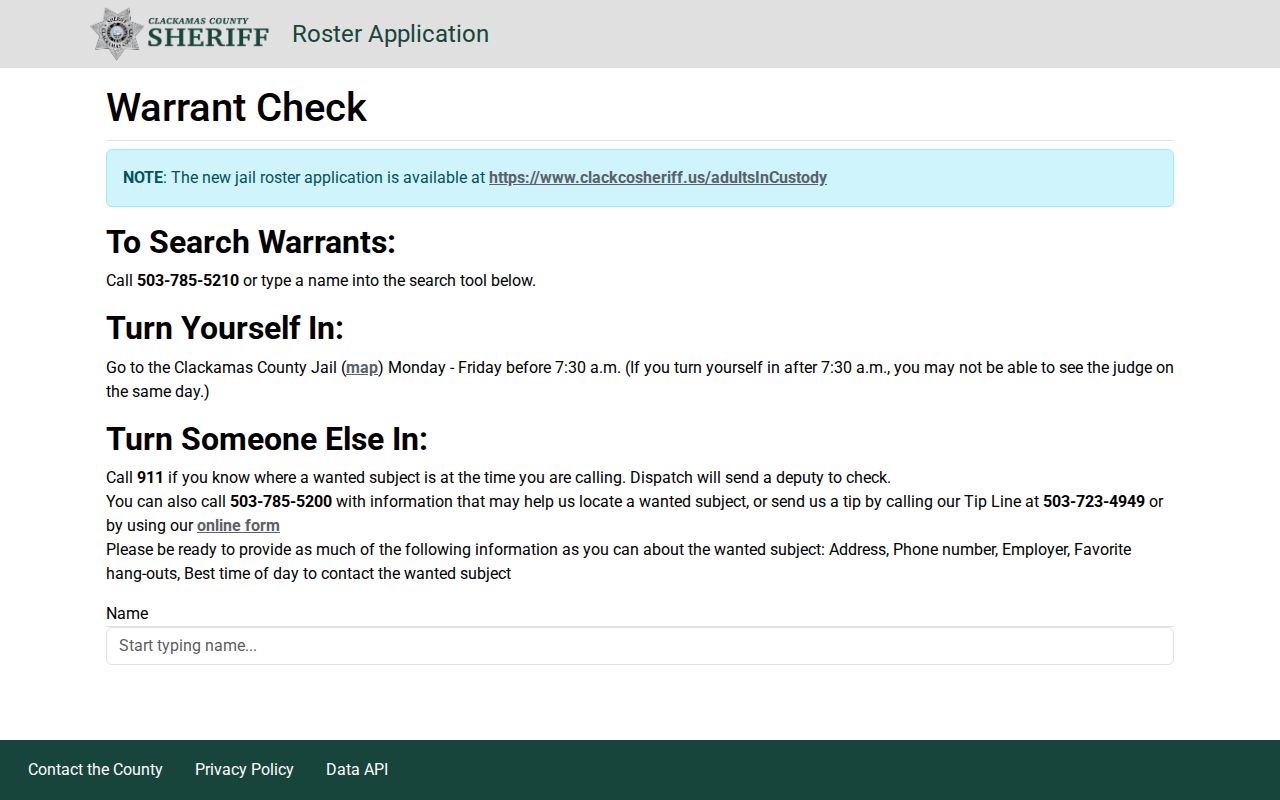
This page is now a handoff and warrant-check route, not a released-person archive. The Clackamas County released inmate lookup provides the named-person decision path across jail, DOC, court, and federal systems.
Clackamas Three-Day Release Fallbacks
Use the custodian that actually held the person. CCSO Records handles a county jail transaction. Oregon DOC's offender search and records unit handle a prison commitment. The BOP locator covers federal imprisonment, and ICE's locator addresses immigration custody. A disappearance from the county list does not answer those other systems.
For future events, Oregon VISOR lets a user register for custody-change notices. An alert is useful evidence of the system-reported event, but it is not a certified release record. For the past three days, the targeted CCSO log remains the main route.
- Released
- Custody ended for the named agency, possibly through a transfer.
- Supervised
- Confinement ended while probation, parole, or post-prison supervision continues.
- Discharged
- The relevant custody or supervision term ended when the official record supports that label.
Clackamas 72-Hour Request Timing
Two different “72-hour” ideas appear in the official material. The user-defined three-day window describes which release events are requested. Separately, the Verification of Incarceration form says most one-person requests are processed within 72 hours. That estimate does not mean CCSO posts a new public list every three days.
For a broad release log, the sheriff's live records page warns that requests are taking about 15 to 20 business days. County policy requires acknowledgement or completion within five business days. An acknowledgement can confirm receipt, ask for clarification, or address fees; it is not necessarily the final record. Oregon law generally requires completion as soon as practicable and provides for a written estimate when more time is needed.
A narrow request is easier to process. State the local start and end times, specify Clackamas County Jail, list only the release fields needed, and ask for segregated nonexempt material. If the fee estimate exceeds $25, Oregon law calls for advance written notice and requester confirmation. This keeps a three-day records question distinct from an open-ended search for all jail history.
Verify Clackamas Release Dispositions
Security release, recognizance, sentence completion, forced release, and transfer should not be collapsed into one label. Forced release is a capacity-management action and does not dismiss the case. A transfer can take a person to Oregon DOC, another county, or another authority. The person has left Clackamas County Jail, but may remain in custody.
A court register supplies the legal event, such as an order, sentence, or dismissal. The jail transaction supplies the physical release time. A receiving-agency record shows whether custody continued. Taken together, those records turn a three-day list question into a verified account of what occurred.
VISOR adds another limited check. It may show current custody or community supervision and can send prospective change alerts. Fully discharged people may fall outside its stated public population, so a blank result cannot close the inquiry. Preserve the actual labels and use the agency record for past proof.